We started our day by crossing the Thames and taking the Northern Line to Charing Cross. This is considered the “centre of London” and it is from there that distances from London are measured. It was clearly a busy place and we easily moved off to Trafalgar Square, the home of a statue to Lord Nelson celebrating a win at the battle of Trafalgar in 1805.
Trafalgar Square
The National Gallery, our primary goal for today, also sits on the square. This year marks the 200th anniversary of the gallery. They celebrated by pulling together a large collection of Van Gogh’s paintings. Some were from the Gallery’s collection, but they also included paintings from other museums and private collections.
The National Gallery“The Bedroom” 1889, Van Gogh Irises“Starry Night Over the Rhone” “Sunflowers”
We enjoyed the special exhibit and appreciated that they controlled the number of people in the gallery at a time. We didn’t feel rushed and could take the time to sit and look at different paintings. After a brief coffee in the Gallery cafe, we continued to the rest of the gallery. There was much to see.
Caravaggio (1571-1610) Salome receives the head of John the Baptist, one of his last paintings. Caravaggio is one of my favourite artists, but a bit of a dark character.Van Gogh’s “Two Crabs“ in the main galleryMichelangelo (1475-1564) “the Manchester Madonna” You know you are important in art history when an unfinished work of art hangs in a prestigious gallery.Massys (1465/6-1530) “An old woman (The ugly duchess)” this one had us chuckling out loud. This is a satirical work designed to get us thinking about aging and beauty. Perhaps Massys was an early feminist?
We left the gallery to head toward Covent Gardens. Covent Gardens was originally a garden for West Minster Abby, but after the dissolution of the monasteries, the land was given to Henry VIII’s advisor, the Earl of Bedford. He hired an architect to develop the land into homes and markets. By 1654 a small fruit and vegetable market was developed. As time went on, the market became seedy with lots of brothels. The clean-up began and by 1830, many of the buildings that we now see were built. Now it is a trendy group of small shops and restaurants. We stopped at the Punch & Judy Pub for lunch and continued to explore the market.
Covent Gardens
The ever so wise Facebook logarithm strongly recommended we check out the Royal Opera building, so we did. The building is relatively modern having been constructed in 1858. We looked around the common areas but couldn’t see the stage as they were getting set up for a performance tonight. We did find the 5th floor viewing area/bar and stopped for a beverage while overlooking Covent Gardens. A wonderful musician serenaded us from below singing jazz standards and playing them on his saxophone.
The Royal Opera House Lobby
We headed back to our side of town to relax before dinner. We met up with our good friend Jane and her travel buddies who had just finished a week of hiking in the Yorkshire Dales. It was good to finally meet the women (Vicky, Susan & Susan) Jane adventures with when she’s not adventuring with us.
We were glad we planned ahead for entry to the Museum. It was crowded and the security took time to get through. Admission to the museum is free but donations are welcome. We realized that some of the money we had from a previous trip to the UK is outdated and vendors wouldn’t take it. We needed to change it at a bank; however, the museum gladly accepted it and saved us a trip to a bank.
The British Museum
There is so much to see in this museum and after a couple of hours we know that sore feet and backs will kick in, so we decided to focus on specific collections. We had seen a movie a while back about the Sutton Hoo Hoard, so we thought we’d focus there. The Sutton Hoo Hoard was found just as WWII started. Basil Brown, an amateur archeologist was tasked by the land owner, Edith Pretty, to excavate a barrow on her land. They found an incredible and rare, intact Anglo-Saxon boat burial. Gold, gems, lyres, helmets and the remains of a large boat were under what looked like a small hill. The hoard is housed at the museum and it was amazing to see the goods they had buried sometime between 410-1000 AD. They had incredible metal and fine metal working skills.
A jewelled purse clasp
We were also interested in the Lewis Chess set found on Lewis Island in the Scottish Hebrides in 1831. They were carved from walrus ivory in the 1100’s. Most of the 94 pieces are in the museum, but there is some challenge to have more moved to the Lewis Island museum.
We had planned to see the Elgin Marbles, a controversial collection of sculpture from the Parthenon in Athens. However, that exhibit was closed for some reason. The controversy about the marbles is about whether to return them to Greece or not. The whole colonial practice of owning another culture’s important historical objects is a hot topic. We were disappointed with one exhibit’s explanation sign that basically said it was ok to have the artifacts in the museum because “they said we could take it”. There was no context provided about what might have influenced the “gift” giving.
We left the museum and explored Oxford Street – mostly window shopping before heading to the Battersea Power Station. We have several tube stations around us, each taking about 15-20 minutes to walk to. We hadn’t tried the Battersea one yet so we were happy to learn that train from there would be the best way for us to take to the National Gallery tomorrow. We never thought about crossing the river before yesterday, despite having seen the Battersea Power Plant building the first day we were here. It seemed so far away but, only a 20 minute walk. They converted the decommissioned power station into an upscale residential and condo development with lots of shops and restaurants.
Battersea Power PlantThe Chelsea bridge over the Thames.
We had an early night, finally overcoming jet lag, as we have an early entry to the National Gallery tomorrow.
We started our day today at the London Mithraeum Museum. While we waited for our entry time at the museum we had to dodge yet another marathon race. It appears like they run a lot in London. Back to the museum, the 2,000 year old temple of Mithra was found when they were digging the foundations for a major building in the middle of London. The museum displayed some of the artifacts they found as well as the foundations of the temple.
Temple of Mithra
We then moved over to the Guildhall Gallery a few streets over. This brought us by the church we wanted to see yesterday. This time it was open. We stopped in to find a wind orchestra practicing. We listened a while and continued on our way.
Mary-Le-Bow church.
The Guildhall has been part of London’s administrative centre for hundreds of years. The part we saw today was built in the late 1880’s. the original design for the building had to change when they found the ruins of a Roman amphitheatre under the planned site. The current building was redeveloped in the 1980’s as the original building was damaged in WWII. We took a guided toured of the art gallery before heading down to the amphitheatre.
Rosetti’s La Chirlandata ( the most celebrated painting in the gallery)The remnants of the Roman Ampitheatre
The original amphitheatre was big enough to hold the same number of people as Roger’s Place in Edmonton (approx 16,000 people).
We headed back to our lodgings by tube and stopped for supper in Sloan Square. After a relaxing meal we wandered by St. Barnabus church, which was also open as a part of the Open London Festival. A lovely lady gave us a tour of the church.
St. Barnabus
We made it home before the rain started and made an early night watching TV. As we were relaxing, we noticed people climbing over a hedge and into the neighbour’s patio. After asking them what was up, we learned that their dog had gotten loose and was trapped on the patio. We had a good chat as they turned out to be neighbours and they gave us some good info on sites to see. Tomorrow we are off to the British Museum.
We set out this morning to check out some of the Open House London events. This annual event invites people to explore buildings that they might not otherwise see. We were on the hunt for St. Mary-le-Bow church. It is featured in the book I am currently reading. We walked around Buckingham Palace and on toward the parliament buildings. We walked (the wrong way) along the banks of the Thames before getting reoriented toward the west-end. Before we turned around however, we were struck by the memorial hearts painted on the wall beside the riverwalk. Each heart paid tribute to someone who died of COVID. It was a long wall.
The COVID Memorial by the Thames
The crowds were intense in Hyde Park as there was a day of kids running races around the park and things were getting set up for a nighttime marathon race. It was also a beautiful day for strolling.
We experienced a smattering of rain as we sat down for lunch but otherwise the weather was perfect. We walked by the London Eye, St. Paul’s Cathedral and finally stopped at St. Bride’s (aka St Bridgette) Church. It had been destroyed during the Fire of London in 1666, rebuilt and then destroyed again during a WWII bombing. It was rebuilt, but in the process they found remnants of buildings from Roman times to present. The display in the crypt showed remnants of all 2000 years of buildings on the site. We finally made it to our original goal only to find the church closed. We peaked inside anyway and went back to a nearby pub to quench our thirst. The pub was historic as well, having survived the fire and the war. The beer was good too.
The Watling Pub near St Mary-Le-BowSt Bride’s ChurchSt Paul’s Cathedral
We took the tube back to our suite and appreciated efficient public transport. No need to buy tickets. You tap your credit or debit card as you get on and off the train. Easy-peasy! Now to figure out where tomorrow’s expedition will take us…
We had a lovely trip across the pond and had no trouble navigating public transit to our residence in the Borough of Chelsea. we wandered along the bank of the Thames until we came to the Grosvenor Pub for our first pint. We were able to pick up some food at a local grocery store so we are all ready to set out for adventures tomorrow.
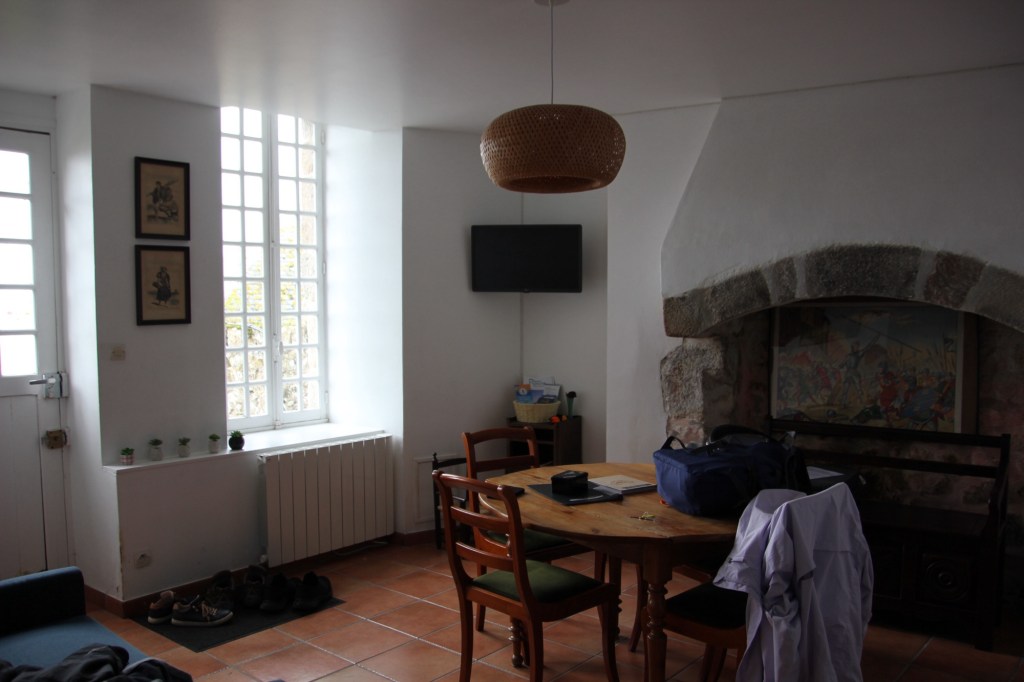
We found our way to our home for the next 10 days. It is a complete apartment in 250-300 sq. Ft. The whole apartment is smaller than many hotel rooms we’ve stayed in. It’s got all we need for a holiday but for most people in the building, this is their permanent home. The Grosvenor canal sits in front of Air B&B (building on the right). it is a lovely setting.
Our last adventure of this amazing holiday was a guided tour to Sintra. We were picked up by our guide, Rui Martin. We left our hotel early and we made the 45 minute drive to Sintra while Rui provided us with an orientation to Portugal and Lisbon as he drove us to Sintra and the Pena Palace. We approached the palace through the park created by King Fernando II surrounding the palace. This garden was a labour of love built with his own money. Fernando was the consort of Queen Maria II of Portugal. He was a wealthy German man and a friend of Prince Albert, husband of Queen Victoria. He was 18 when he married the sixteen year old Queen. She died giving birth to her 11th child at the age of 34.
Fernando bought Sintra, a ruined monastery, and several of the surrounding properties, including the ruined Moorish castle on a nearby hillside. He then took to building a romantic garden. His vision was a response to the rationalism of the French enlightenment. What this meant was he created a garden that had none of the geometric lines of, for example, the French palace of Versailles or the other formal gardens of the previous era. Fernando created a garden of organic shapes with beautiful follies that reflected aspects of the ruined monastery he set out to restore.
Maria died in 1853 at the age of 34 during the birth of their 11th child. Seven years later, Fernando fell in love with a British/Swiss opera singer. The Portuguese aristocracy were not happy that he was in a relationship with a commoner, so the king of Belgium made her a countess and they were married in 1869. Together they continued to develop the properties, including a private chalet outside the palace. All this development was paid for out of Fernando’s own funds.
The Pina Palace started life as a monastery founded by King Manuel I. Apparently Manuel was a monstrous king. He expelled the Moors and the Jews from Portugal and started the Portuguese inquisition. Rui was happy to see that Fernando was able to transform Manuel’s monastery, where wayward monks were sent as punishment for acting out. The yellow stuccoed buildings are Fernando’s, the red stucco is the original monastery.
The main entrance to the inner palace was my favourite part of the castle. It was protected by Poseidon, God of the Sea and was filled with beautiful ceramic tiles.
Poseidon watching all who enter.The courtyard looking up at the chapel (beside the chevroned spire)
We appreciated learning the full story of the palace as we walked through the deliberately wild gardens. The calm of the gardens was a juxtaposition to the chaos of the crowds of the palace itself. Rui encouraged us to focus on the exterior and the story rather than the internal trappings of the Victorian era. The one interior we did explore was the chapel, original to Manuel’s time. It survived the earthquake of 1755 and remained as it was with the exception of the stained glass window. If you look closely at the chapel window in the pane with the king in front of the chapel , you will see the modern stained glass window in the chapel.
We loved the walk around the outer walls and the view out to the sea. We looked out over the thousand year old Moorish castle from the palace walls. Castelo dos Mouros was build in the 10th century when Portugal was under Islamic rule. The Moors lived in the castle until 1147 when Afonso, the first king of Portugal reclaimed Lisbon and surrounding area. The king gave the Knights Templar the charter to manage the area in 1154. We didn’t have time to look inside the castle, but it looked like a great place to explore next time we are near.
We then descended back into the lines of people, the chaos of cars and then back into the garden for a stroll back to the van. We had lunch in Sintra village before hitting the road to find the most westerly point of continental Europe. It was weird to look over the ocean and think that the next port is Washington DC. The seashore was windy but worth the need to hang onto our hats.
We drove back to Lisbon via the Portuguese Riviera. It was lovely to see the Portuguese version of Banff. Salazar, the Portuguese dictator until 1974, kept Portugal neutral during WWII. This allowed him to curry favour with both sides of the conflict. Portugal, and especially this seaside resort, became an ideal place for spies to gather. Ian Fleming is said to have been inspired to create James Bond from this activity in this community.
We spent our last evening at a local Portuguese restaurant across the street from our hotel. The host directed us to a reserved table as if he had been waiting for us. He spoke no English and, as we engaged in pointing and pantomime to express our choices, he was clear that we could only order the small sizes on the menu, no matter how hungry we felt. He was correct, the food was plentiful and authentically Portuguese. The wine was excellent as we happily brought our Portuguese adventure to an end.
We left our ship and were transported to the train station where we caught the train to Lisbon. The trip took approximately 3 hours. We caught glimpses of the ocean and sped through small villages. The countryside was pretty dry and fairly boring so, it was a good time for a bit of relaxation. We navigated the Lisbon train station easily and made good time getting to our hotel.
The Alegria is a lovely, century-old building (circa 1870’s) adjacent to a quiet park. It was a few steps from the main avenue, lined with every high end fashion outlet you could imagine. We strolled up and down the avenue admiring the offerings of street vendors set up all down the mosaic tiled sidewalks.
Lisbon was destroyed in 1755, first by the earthquake and then by the subsequent tsunami. The rebuilding focused on moving into future rather than rebuilding the past. As a result, the city was rebuilt with wide avenues and large squares. The mosaic cobblestones are a distinctive part of the cityscape and added a lot to the ambiance of the city.
Lisbon is built over 7 hills, so walking always involves as much up as down. We took a hop-on-hop off tour of the city to get our bearings. We split up and while some of us went exploring shopping options, Dale and I took the funicular up to a promenade overlooking the city.
We then wandered back to our hotel only to encounter a swing jazz ensemble in the park outside the hotel. It was magical to sip cold beer, sit in the shade, avoid the 30 degree heat and listen to great live music on a Sunday afternoon. Dancers from a local dance school showed their moves despite the heat. It was a good day. We finished the day with a delicious meal of Indian food a few doors down from the park.
The last day of our cruise took us back into Porto. We were grateful for another day to explore this city. We spent the morning shopping and found ourselves in a delightful shop specializing in cork products.
This is cork bark before any processing. These are some of the souveniers we brought home. – missing – Dale’s apron, yes, an apron made of cork!
After lunch we took the trolley out to the Atlantic Ocean. This delightful 20 minute long ride took us along the Douro river to the sea.
We enjoyed walking along the piers and watching the waves crash against the rocks.
We returned to the ship and they took us for a bit of a cruise before serving us our last dinner on board.
Lamego is a small town with a big shrine. There was a roman settlement here and an early adopter of Christianity (570AD). There is a castle and a cathedral but most people come to see the shrine and church of Our Lady of Remedies. The church was started in 1761 and finished in 1905. It is built on a hill high above the town.
There is a fountain outside that is said to have healing waters. People come from far around just to fill up bottles with this good-for-you stuff. We filled our water bottle and had a very healthy day.
The church was beautiful inside.
Despite the beauty of the church, most people are in awe of the 686 steps linking 9 terraces leading down to the town. The stairway is a setting for the stations of the cross and encourages pilgrims to reflect and meditate at each station. However, my hunch is that now there is less meditation and more of a focus on the physicality of making the trek either up or down the stairs.
We spent some time wandering this quaint village and explored the local farmer’s market. The focus was on the practical rather than the touristic. There were many stalls with vegetables and plants, as well as bunnies and a variety of chickens and other birds.
There was an option for people on the tour to skip the town and go visit the other important site at Lamego, the Mateus Palace. many of my generation will recall Mateus wine, a sweet concoction that convinced many of us in our youth, that wine was not a good binging beverage. The palace is still owned and occupied by the Mateus family. The prize our group won at the trivia night later on this day was a bottle of Mateus wine. It was much better than I remembered, but still I had no need to buy some to bring home.