• About

travelswithannmarie

~ This blog is an opportunity to share my travel experiences

travelswithannmarie

Monthly Archives: January 2013

Happy New Year

02 Wednesday Jan 2013

Posted by travelswithannmarie in Uncategorized

≈ Leave a comment

Sorry for posting this out of chronological order – I had a bit of computer glitch. Happy New Year to all.

January 1, 2013

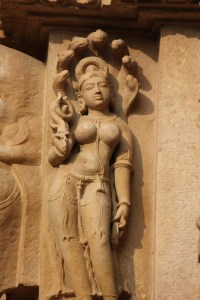
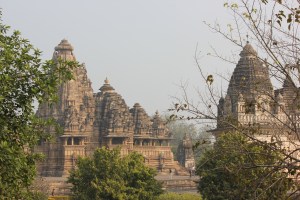
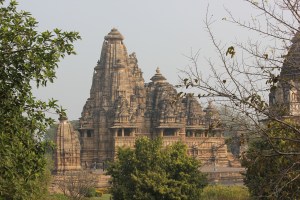
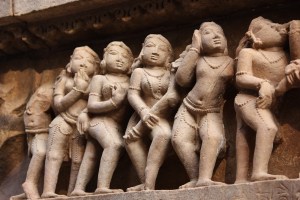
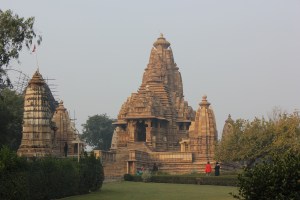
Happy New Year every one! We started our new year in Khajuraho temples where the Kama sutra carvings were built over 200 years, from 950 to 1150. The local people always knew about the temples but they became overgrown by the jungle. In the 1800’s a British soldier found them and started the restoration process with the blessings of the Indian Archaeological Society. The temples are now a UNESCO World Heritage site and are considered one of the seven man-made wonders of the world! We have now seen 4/7 including Chichen Itza in Mexico, the coliseum in Rome, and The Taj Mahal and the Khajuraho temples.

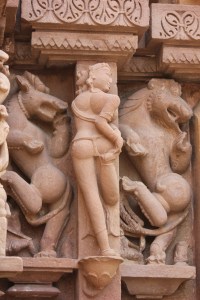
The temples were fascinating. The carvings depicted Hindu gods, goddesses, and scenes from daily life or military life. The carvings were made to help people to prepare to go into the temple. The guide said that the temples were built with the idea that you would first walk around them in a clockwise direction so that you would start to shift your focus from worldly concerns to a more meditative, mindful state. If you looked at the carvings and they distracted you by the content, you were not ready to go in. Keep walking! The graphic sexual imagery was not designed as pornography but as a means of confirming sex as a normal and important aspect of life. The carvings were all made from stone and are freestanding statues connected to a huge brick. The temples were made with an interlocking block pattern (like really big Lego) and no mortar was used. We walked around the site for a couple of hours. This is one of those places where you have to stop looking after a while because you can’t actually take it all in. I am posting pictures that have a PG content because I don’t want my sisters to have to explain the facts of life to their kids (assuming that they may not have done “the talk” yet).
??????????????????????????????????????? 2012-12-31 Kamasutra 036 2012-12-31 Kamasutra 066 2012-12-31 Kamasutra 138 2012-12-31 Kamasutra 139 2012-12-31 Kamasutra 174

We felt a little battered by our drive. We knew that it would be at least a 6-hour drive to our next stop. However, the road was under construction and we took an hour to travel 20 kms. Road building here is interesting. They dug up the whole road and started to construct the new one. People did not stop using the road while it was being built. You just went around the workers and avoided the big potholes. We felt like we were doing off-road driving without the 4-wheel drive! Of course, not only did the driver have to deal with insane road conditions, he also had to manage a huge amount of traffic passing him in both directions and then his screen fogged up because it got colder after dark and he had no heater. We arrived shaken but intact.

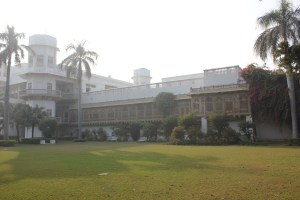
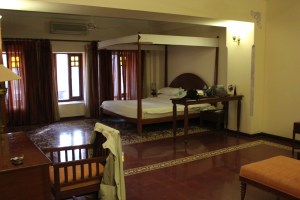
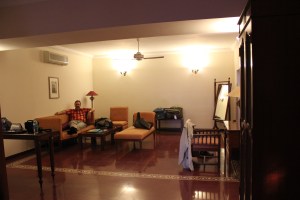
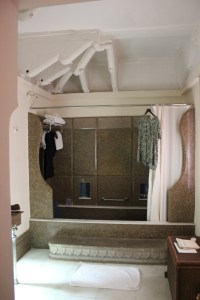
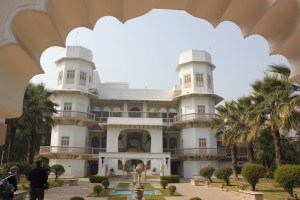
The hotel was worth the drive. We are staying in a palace! Seriously, a palace owned by a Maharaja who still lives in one wing. The Prince of Wales stayed here! OK, that was 100 years ago, but it is spectacular. This is only the guesthouse. We will get to see the actual palace on January 3.
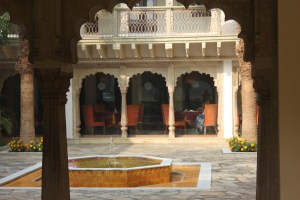
2013-01-01 Gwalior 182 2013-01-01 Gwalior 194 2013-01-01 Gwalior 209 2013-01-01 Gwalior 220 2013-01-01 Gwalior 221 2013-01-01 Gwalior 222 2013-01-01 Gwalior 223

Gwalior, a very storied place

02 Wednesday Jan 2013

Posted by travelswithannmarie in Uncategorized

≈ Leave a comment

Tags

Gwalior Fort

Image

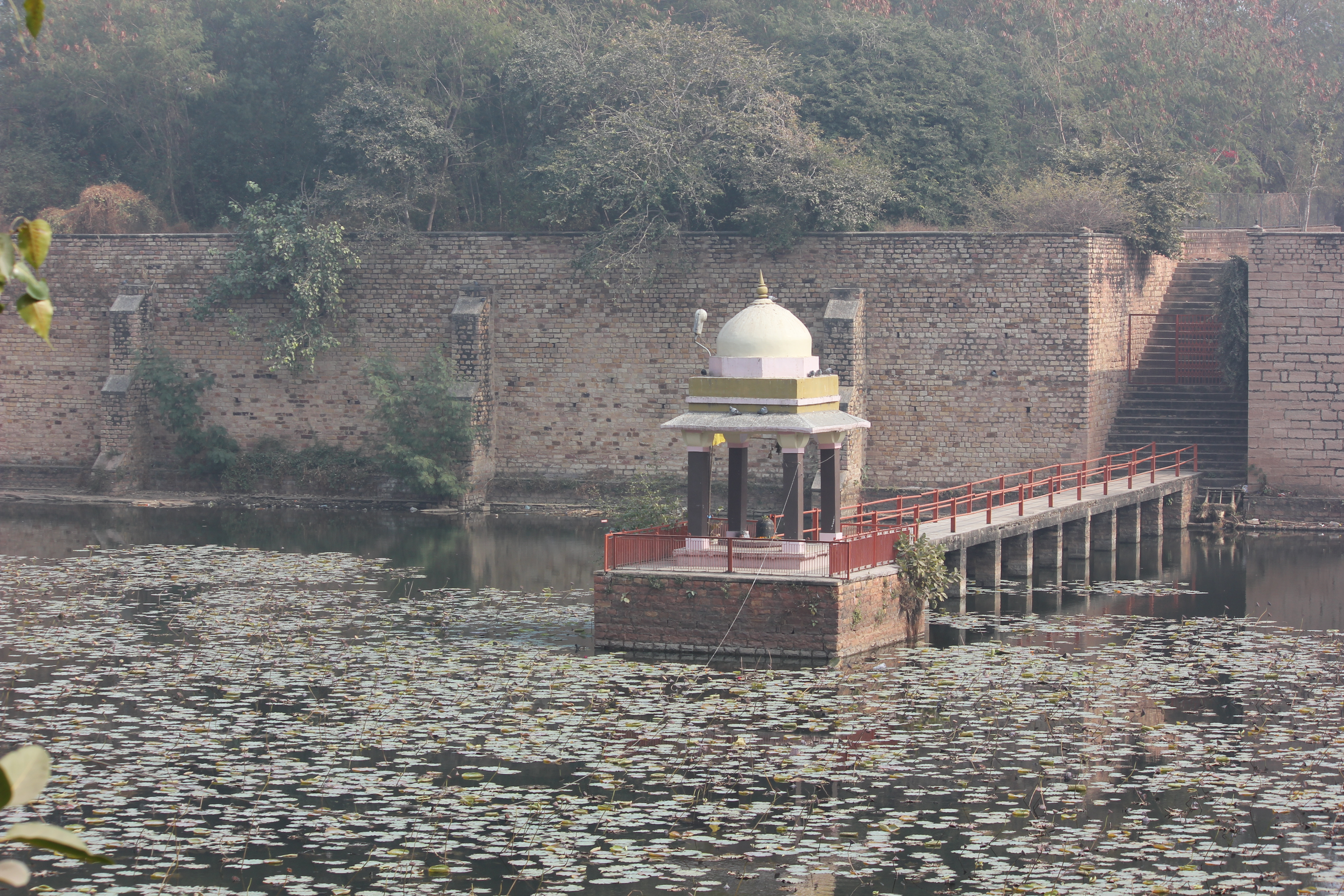
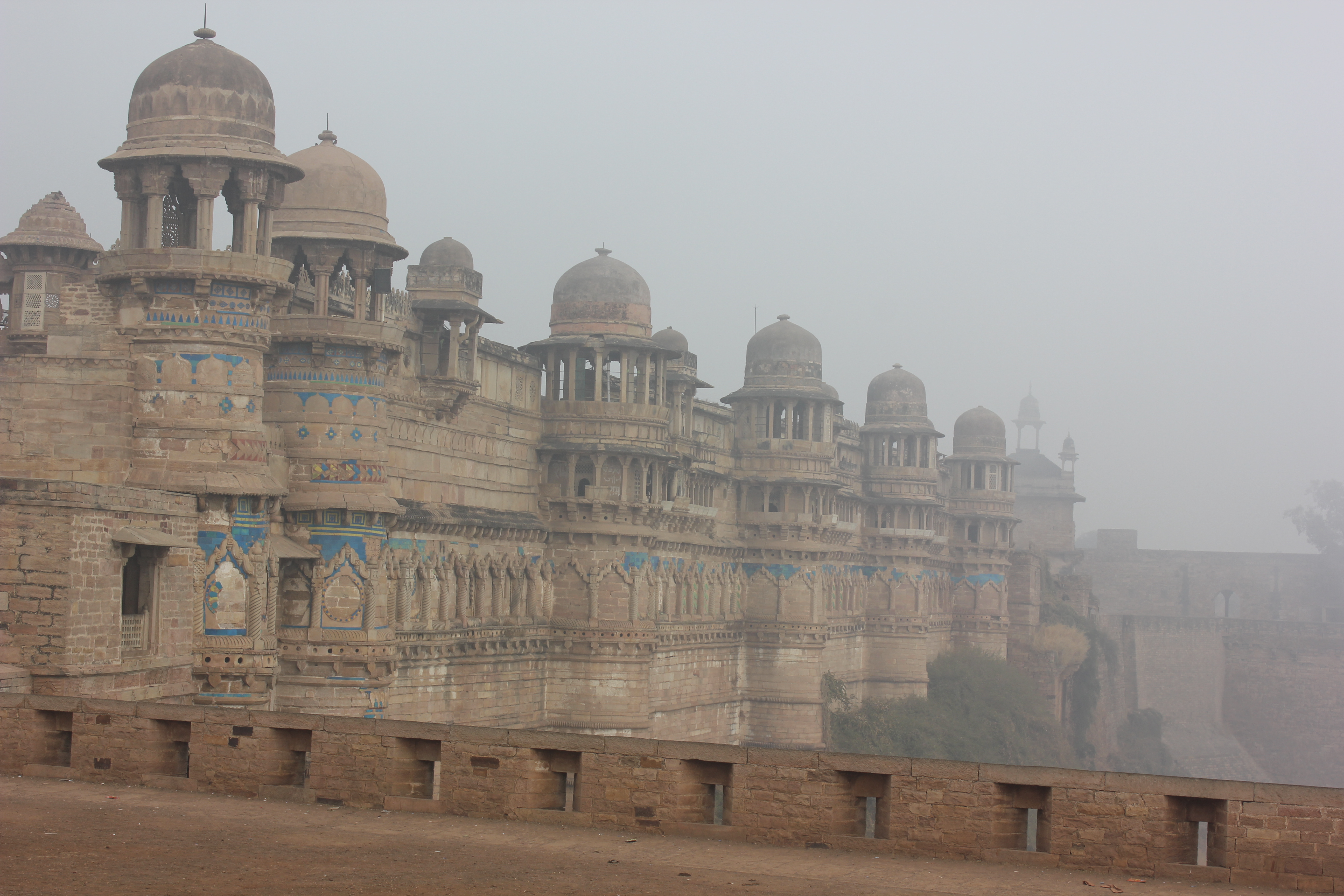
What an experience today. We went to the Gwalior Fort. Legend has it that the King was hunting in the forest and needed water. He had a hard time finding some and was getting concerned when he came upon a wise man. The man had water from a spring and encouraged the king to drink from it. The king happened to have leprosy, a common disease. After drinking the water, he was completely cured of his leprosy. The king went on to build a basin for the water and built a palace nearby. To this day, people come to the basin, pray, cleanse themselves in the water, and the story goes, continue to be healed from leprosy.

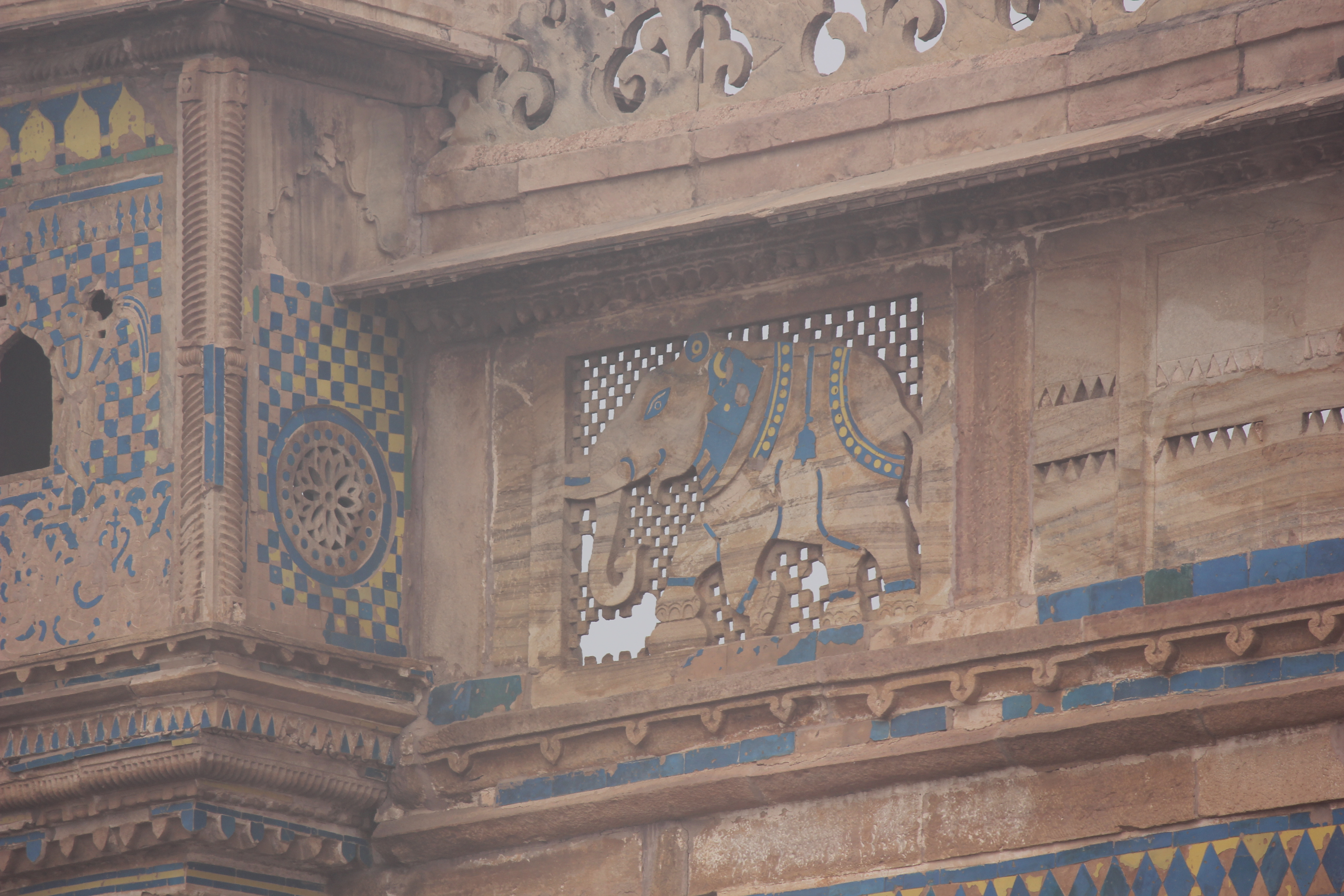
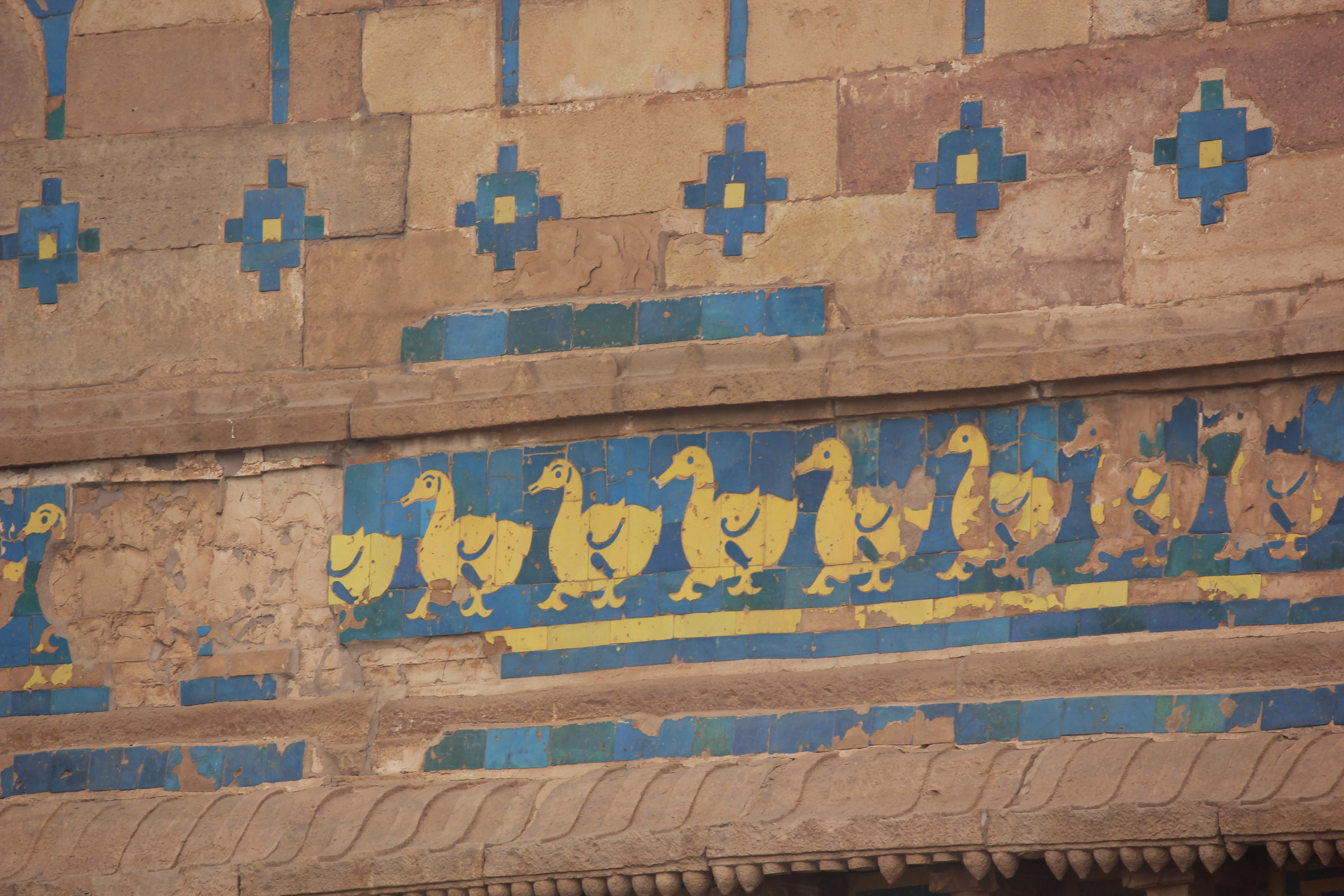
Imagethe fog makes it hard to see the panels at the top, here are close ups of the elephant (lapis Lazuli) and the ducks (Jasper).

ImageImage

Gwalior was a busy place after the king discovered the water. There were a number of dynasties that ruled the area. The Moghuls took over for a while and of course, didn’t like the statuary showing people or animals. They went around breaking much of what they could reach. In the 1500’s one of the rulers built a palace to house his 8 wives. The problem was that despite the number of wives, he had no children. The story we have heard several times is that the king was out hunting and came upon a village where there was an uproar occurring. A girl was wrestling with two bulls who were butting heads. She separated them. The king was so intrigued that he proposed to this woman on the spot. She decided to accept the proposal under 3 conditions: 1) that she be able to show her face (without being veiled) or be forced to live behind the screens in the palace like his other wives; 2) that she could go into battle with him and be an active, working person rather than pampered like his other wives; and, 3) that she continue to have access to the water from her home village because that was, in her belief, the source of her strength. He agreed to the conditions. He built a water transportation system to get water from her village well pumped to the castle. The king had one son with his 9th wife and all was right in the world.

The Palace we toured had originally been covered in Lapis Lazuli and Jasper. The blue or yellow stones were ground to dust and added to the paint. The domes of the palace were coated with gold originally. It must have been spectacular. There were several sacred animals depicted on the walls. The ducks represented peace and knowledge, Tigers represented power, the crocodiles represented the Ganges water, the elephant represents wealth and prosperity and the rest I don’t remember. Meenal may be able to add to this for me (or correct me). Regardless of the meanings – the walls were fantastic. This was a truly magnificent structure! I loved the guide’s ability to tell a good story too!

The spa at our hotel has a treatment where you get to soak in a tub filled with the water from this village. It also includes having a massage, a body wrap and, aromatherapy. It would take 3 hours and a live musician sitting behind a stone screen played music designed for the process. I was tempted. Image all that for 5000 Rupees (move the decimal over two places and double… $100/cdn)! Tomorrow we are going for a one hour long foot massage/reflexology treatment. It will cost us 1600 Rupees – well worth it after a long session of sightseeing at the Raj’s palace and while we wait to head back to Dehli, again, for the night.

An interesting tidbit of information from that highly reliable source, wikipidia, Gwalior temple has the very first occurrence of zero as a written number in the world.

A few moments by the side of the road.

02 Wednesday Jan 2013

Posted by travelswithannmarie in Uncategorized

≈ Leave a comment

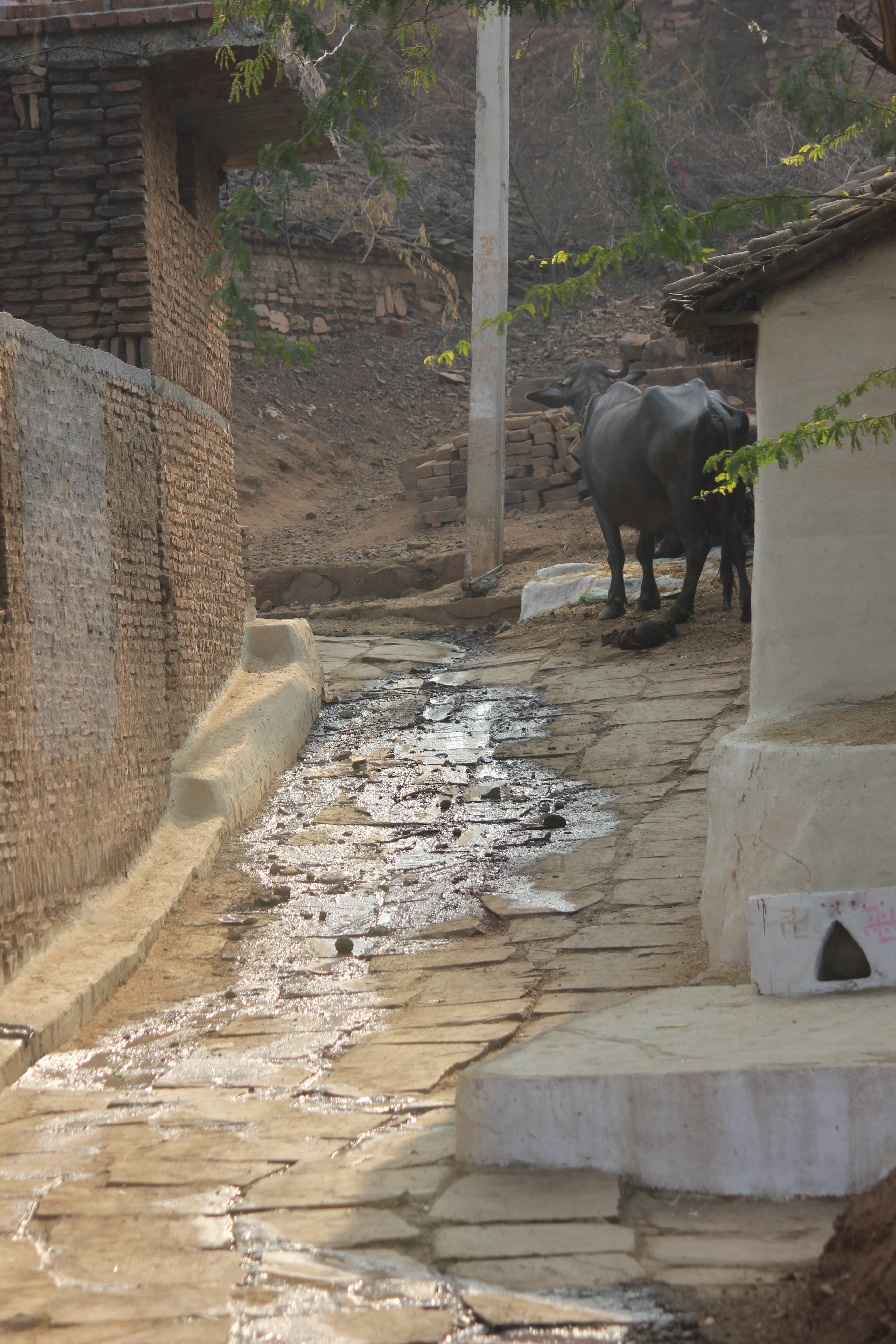
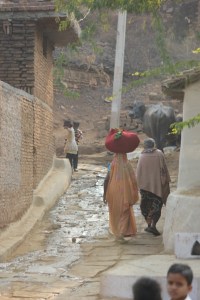
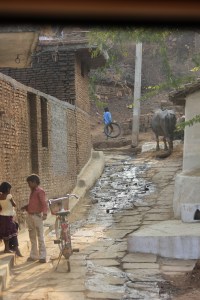
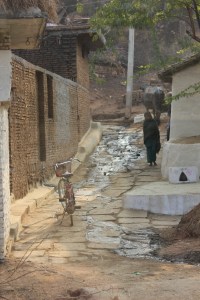
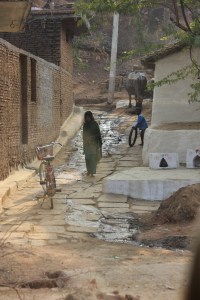
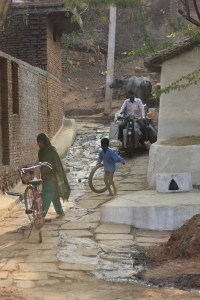
Our driver stopped to check his spare tire before our long drive to Gwalior. We stopped in a small village for about 20 minutes. This lane was near the van. We were taken aback by the activity that occurred in such a small space in such a short time. One of the conclusions I have had about India is that Life happens near the road. Image2012-12-31 Kamasutra 2792012-12-31 Kamasutra 2852012-12-31 Kamasutra 2862012-12-31 Kamasutra 2882012-12-31 Kamasutra 2912012-12-31 Kamasutra 2922012-12-31 Kamasutra 2942012-12-31 Kamasutra 295

Orchha and beyond

01 Tuesday Jan 2013

Posted by travelswithannmarie in Uncategorized

≈ Leave a comment

(December 31) We stated off in the dark again today. The sun rises around 7 am and sets around 6 pm. We ate an early breakfast and were off to catch a train. The train was relatively on time and waiting was interesting. There are three types of people helping us on our travels. The first is a handler – the person, who keeps us organized, meets us off planes, trains or boats. The second is a driver. Finally, we meet local guides who take us through the sites. The handler today met us looking less than thrilled. It was cold and he looked bored. Regardless, he took us to the train station and helped us manage to avoid the crowd of beggars and get on the right train. The beggars were heart breaking. Lots of them were maimed, disfigured or carrying small children.

We got on the right train and our job was to make sure we got off at the right station, Jhansi. Like many public announcement systems, we found it hard to hear what was being said even though they made all the announcements in English too. Our steward helped us get our bags down on time and stacked them at the door of the car, for a tip of course. Then we had to get off the train very quickly and with all our bags, because the train did not stop for more than a few minutes. It worked. Our new handler picked us up, gave us to our new driver and off we were to Orchha to see the palaces of a Moghul king.

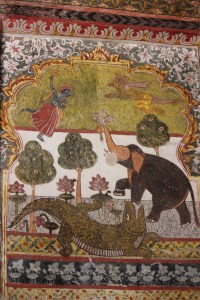
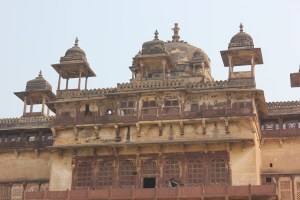
Palace paintings - after 400 years!Orchha palace2012-12-30 December 31 new 089


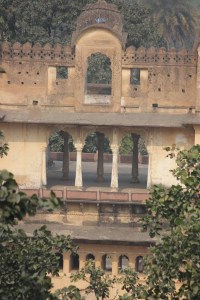
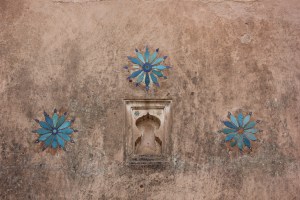
We were shown beautiful examples of a blend of Hindu and Islamic architecture. The shapes of screens, domes, doors and minarets all showed the dual influence, as did the inclusion of blue/green ceramic tiles. The paintings in one of the castles were spectacularly vivid. It really gave an idea of what the place must have been like when it was in use. Carpets hung from the walls in winter and curtains in summer. It would have been a highly colourful place. The first palace we saw, i.e., the one with the bathroom, is now an Indian state run hotel and for 5000Rupee/per night (or $100cdn) you can sleep in the king’s bedroom. The second one was built for the king who only stayed in it for one night! The third one saw more use.

Hindu/Islamic design

We had a mediocre meal (one of the few so far) for lunch at a buffet designed to meet the needs of bus tour groups. Not my favourite! We are getting picky now since we have had such great food almost everywhere. Our hotel had an outdoor celebration for New Year’s Eve and we had a great time. Our next stop is Khajuraho for our new year’s party. Happy New Year everyone!

The Taj Mahal

01 Tuesday Jan 2013

Posted by travelswithannmarie in Uncategorized

≈ Leave a comment

Tags

Taj Mahal

(December 30) We were up at the crack of dawn, literally, and we were off to Agra. For the first time I was able to read in the van. I cannot believe that in only three weeks I am no longer totally freaked out by the traffic.

We learned a lot about the Moghul rulers. First, there was Akbar (1542-1605), then Jahangir (1005-1627), Shah Jahan (1628-1658) and Aurangzeb (1658-1707). After Aurangzeb died, there was a lot of jockeying for power within India and eventually the British took over.

Our first stop was the mausoleum where Akbar’s tomb lay. The building, built in 1605, was magnificent – all for a dead person! Akbar was the third Moghul ruler of India. The Moghul’s came from Uzbekistan and ruled India until the British came and took over. The mausoleum had been badly looted and the British Governor General Lord Curzon, the same person who saved the caves at Ajanta saved the mausoleum. Our guide told us that the archaeological work in India really improved after the 1980`s when they received UNESCO funding to save some of them.

We then went to Fort Agra. This was an immense fort built by the Moghul rulers and 75% of it is still used as a military site by the Indian army. I could have all my facts wrong as there was a huge amount of information given to us by the guide and I had to choose between taking notes or pictures. I chose pictures. I defer to Meenal`s history of India if she chooses to comment J. The man who built the Taj Mahal (i.e. Shah Jahan) was a huge builder of monuments. He engaged in so many that his son, Aurangzeb, actually took over and imprisoned him in the fort to stop him from building anything more. His son believed that although all the building projects gave good employment opportunities to the workers, it was still too much of a drain on the king`s purse and didn`t leave enough for supporting his people in times of trouble. The king died in prison. From his wing of the fort he could see the Taj Mahal but as his eyesight dwindled, they placed a diamond in his room so that it acted as a reflecting mirror and he could continue to see his wife`s tomb. The king had a throne in the fort that was jewel encrusted. When the tomb was looted, the throne was taken to Iran and it became the Peacock throne of the Shah. The big diamond from the throne was called the Koh-I-Noor diamond. It was returned and given to Queen Victoria. It is now in the crown jewel collection in London.

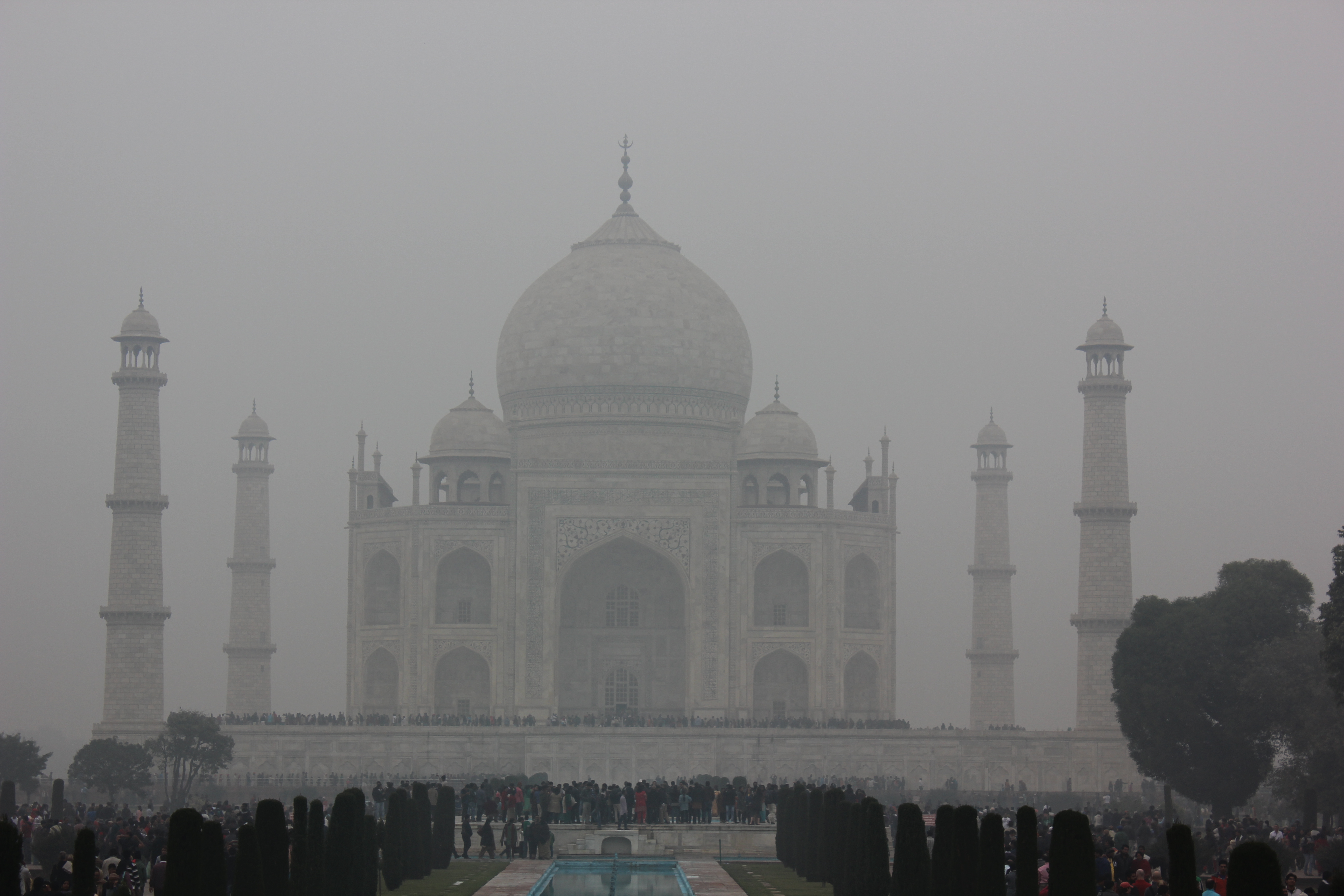
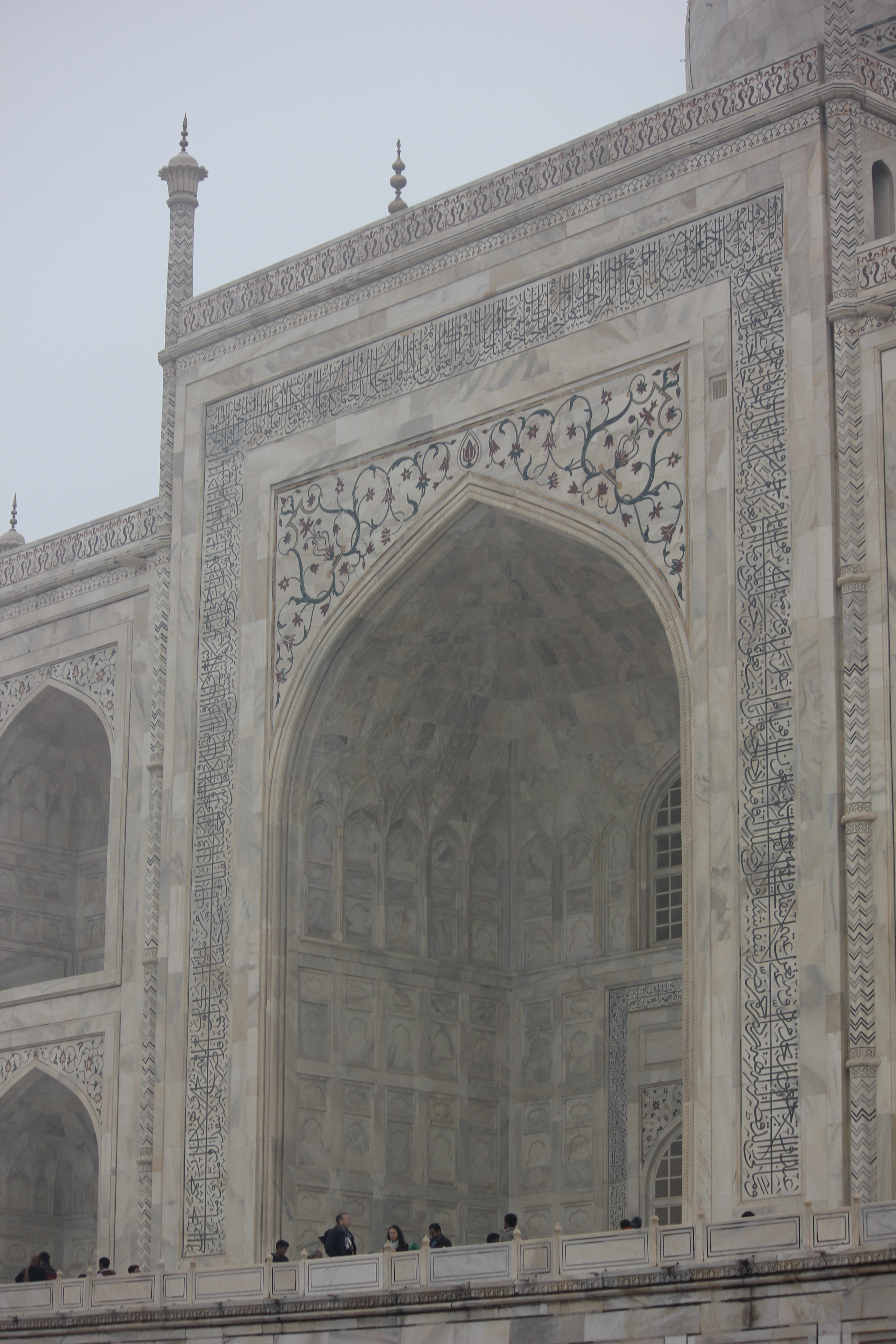
The Taj Mahal was magnificent. We first caught a Tuk Tuk – an organically friendly electric one, because all motorized traffic is limited around the Taj Mahal. The government is trying to protect the monument by shutting down smog producing industries within a 60-mile radius. We went through the amazing gate that was stunning on its own, and got a glimpse of the monument. Wow. The fog made it difficult to see the monument but it took our breath away anyway. Shah Jahan had three wives. The first two didn`t give him any sons. The third wife, his favourite, died giving birth to their 13thImage child. At least one son survived. He built the Taj Mahal in response to her request that he build her a monument after her death that would not allow others to forget the beauty of their love. It took 20,000 labourers and artisans 17 years to build the Mausoleum and another 8 years to complete all the structures on the grounds. The Shah had planned to build a black version of the Taj Mahal on the other side of the river from his wife`s tomb, but didn`t get to do it because his son imprisoned him. Therefore, the Shah was entombed in the same space as his wife; his tomb is the only non-symmetrical part of the entire complex.ImageImage

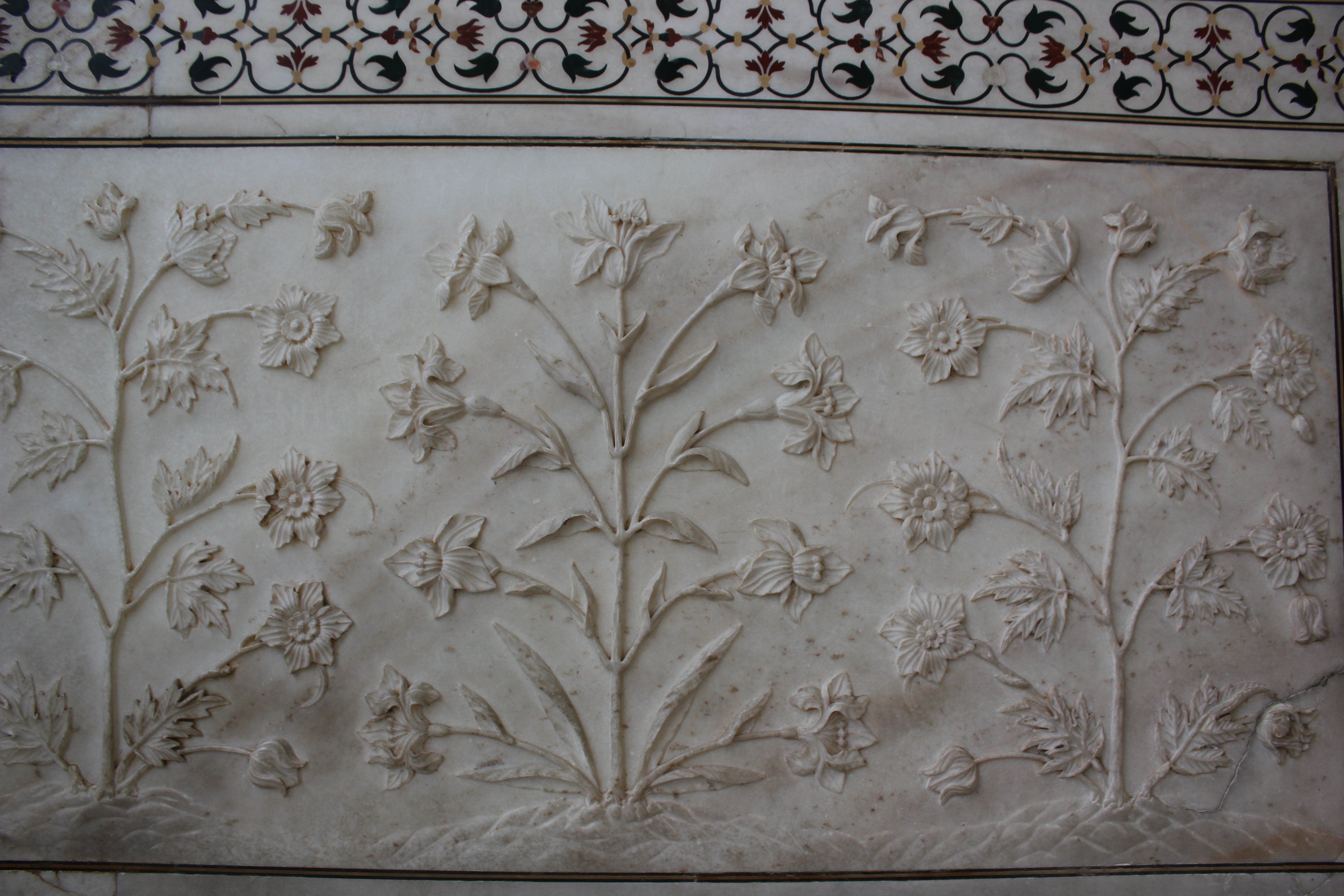
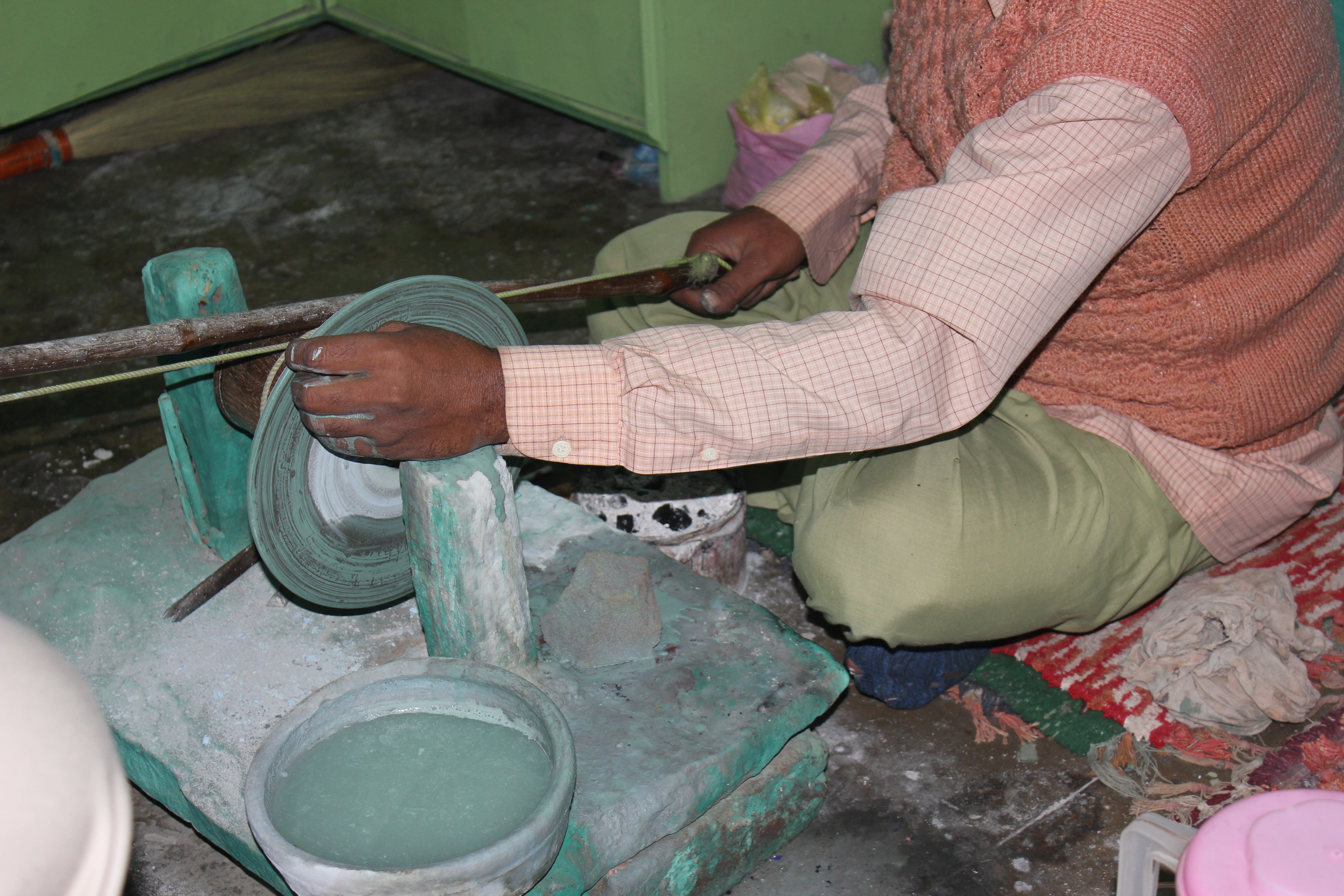
Our last stop of the day was a factory store that showcased the inlaid stone artisanship that was used to build the Taj Mahal. The carvings and inlaid stones were amazing and hard to describe. The artists who did the original work were brought from Persia and their descendants continue to do the work in the same way, using the same tools that their ancestors did. They showed us how they cut and polish the stones, carve the marble and inlay the stones. Then they showed us the showroom and the negotiating began. The pieces were beautiful and it was hard to choose 1) something we could carry with us and 2) something we could afford! We managed somehow.Image

Newer posts →

Recent Posts

  • A day in Montreal
  • A final day in Paris
  • Paris Day 2
  • Paris- Day 1
  • Our final day in Normandy

Archives

  • December 2025
  • June 2025
  • May 2025
  • December 2024
  • September 2024
  • September 2023
  • March 2023
  • February 2023
  • August 2019
  • July 2019
  • April 2019
  • March 2019
  • September 2018
  • August 2018
  • June 2015
  • July 2013
  • June 2013
  • January 2013
  • December 2012
  • November 2012
  • September 2012

Categories

  • Bucket List Travels
  • Uncategorized

Meta

  • Create account
  • Log in
  • Entries feed
  • Comments feed
  • WordPress.com

Blog at WordPress.com.

  • Subscribe Subscribed
    • travelswithannmarie
    • Join 99 other subscribers
    • Already have a WordPress.com account? Log in now.
    • travelswithannmarie
    • Subscribe Subscribed
    • Sign up
    • Log in
    • Report this content
    • View site in Reader
    • Manage subscriptions
    • Collapse this bar
 

Loading Comments...