
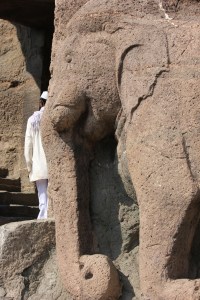
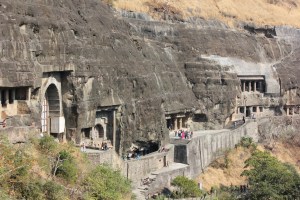


 We had a very early start today. We were on our way to the Mumbai airport at 4 am for our 6:30 flight. We arrived in Aurangabad (Aurangzeb’s city) at 8:30 am and our guide picked us up and transported us to our hotel – a virtual palace of a place. After dropping our gear, we were off on our two hour drive to the Ajanta Caves. We were initially concerned about being anything but comatose after such an early start, but the caves were fascinating. They were more appropriately called carved mountains than caves because the Buddhist monks living there between 2AD and 6 BC carved the temples and monasteries out of solid rock, creating the caves. Our guide was brilliant. He has been guiding people through the monument for the past 42 years! He knew everything about the caves and was still passionate about making sure we understood the significance of the caves.
Our travels to and from the UNESCO World heritage site were delayed a couple of seconds because we had to wait for ox carts to move off the road. It is staggering to note that people still use ox carts, live in huts and walk miles for water. This is the reality for many of the people living in and around Arangabad. The poverty here is obvious. However, for many of the people we encountered, it was “just life” and they were accepting of how life was. We saw migrant worker “villages” filled with tarp-tents. A whole family would live in the tent while picking whatever was being harvested. The crops around here included sorgum, sugar cane, lentils, wheat, ginger, fruit, castor, red chilli peppers and cotton. They use oxen to transport their goods to and from the field.
We ended our day at a weaving school. The weavers there use three different types of looms. The first loom they showed us was based on 2000-year-old traditions of tapestry with silk threads. It takes one weaver over two years to make one Sari using this technique. The people of the Aurangabad area are some of the originators of loom weaving in the world and the school is trying to preserve the traditional weaving techniques. The second loom technique they showed us was mechanized but on a 600 year old style of loom. An early computer helped speed up the weaving process. The third loom was only 300-year-old technology. It used a punch-card system that resembled the computers of the 1980’s. The two looms would automatically pick up specific warp threads so the shuttle could weave the pattern. We ended up buying a whole swack of goods and enjoyed the whole process.
 travelswithannmarie
What an education you are getting, beautiful pics – Jane
we are having a blast. can’t wait until you join us. the service has been brilliant and we are happy with all the activities we have experienced!
That is cool aunty Ann Marie. You use big words. Mommy helped.where will you be for Christmas? We do weaving looms at school. Love Katie
Hi Katy, Sorry for my big words, India is such a big place that big words seem to come to mind. The looms in this place were amazing. Do you know what a sari is? the Indian women wear them all the time. A man was making a sari for a woman’s wedding gown. He will work on the fabric for 2 years because it is so complicated. can you imagine doing something for two years 5-8 hours a day so someone can have a dress? I bought a few things at the shop that were made using the 300 year old process. My one scarf took someone three weeks to make. It cost 3000 Indian rupees or in Canadian money that would be $60.